Free Part 107 Practice Test
This free Part 107 practice test uses all 46 official FAA sample questions for the Remote Pilot (UAG) knowledge test, including real chart figures. There is no sign-up. After every answer you get instant feedback with a clear explanation and the ACS code, so you know exactly which knowledge area to review.
Choose how to practice
Or practice by area
Questions and figures: FAA Remote Pilot (UAG) sample questions, a public domain work of the U.S. Government. The FAA does not publish an answer key; answers and explanations are provided by Part 107 Prep and are not official. Part 107 Prep is an independent study app and is not affiliated with the FAA or PSI.
All 46 FAA sample questions
Regulations
2. According to 14 CFR part 107, how may a remote pilot operate an unmanned aircraft in Class C airspace?
- A. The remote pilot must contact the Air Traffic Control (ATC) facility after launching the unmanned aircraft.
- B. The remote pilot must monitor the Air Traffic Control (ATC) frequency from launch to recovery.
- C. The remote pilot must have prior authorization from the Air Traffic Control (ATC) facility having jurisdiction over that airspace.
Show answer
Correct answer: C. The remote pilot must have prior authorization from the Air Traffic Control (ATC) facility having jurisdiction over that airspace.
§ 107.41 requires PRIOR authorization before operating in Class B, C, or D airspace or within the lateral boundaries of Class E surface areas. In practice you request this through LAANC or the FAA DroneZone, not by radio, and never after launch. Monitoring the ATC frequency is neither required nor sufficient.
ACS code: UA.I.B.K16
6. Which technique should a remote pilot use to scan for traffic? A remote pilot should
- A. systematically focus on different segments of the sky for short intervals.
- B. concentrate on relative movement detected in the peripheral vision area.
- C. continuously scan the sky from right to left.
Show answer
Correct answer: A. systematically focus on different segments of the sky for short intervals.
The eye detects traffic best when it is stationary, not while sweeping. The FAA therefore teaches sector scanning: divide the sky into segments of about 10° and focus on each one for at least a second before moving on. A continuous sweep looks thorough but lets your eyes glide right past conflicting traffic.
ACS code: UA.I.B.K14a
27. According to 14 CFR part 107, what is required to operate a small UA within 30 minutes after official sunset?
- A. Use of a transponder.
- B. Use of anti-collision lights.
- C. Must be operated in a rural area.
Show answer
Correct answer: B. Use of anti-collision lights.
Thirty minutes after official sunset is still inside evening civil twilight. § 107.29(c) sets that window as official sunset until 30 minutes after it, and morning civil twilight as 30 minutes before official sunrise until sunrise; the stretch between the two windows is night. Civil twilight and night both require anti-collision lighting visible for at least 3 statute miles, with a flash rate sufficient to avoid a collision. Since the 2021 rule change night flight needs no waiver, but it does need that lighting plus the updated night training.
ACS code: UA.I.B.K9
29. According to 14 CFR part 107, who is responsible for determining the performance of a small unmanned aircraft?
- A. Manufacturer.
- B. Remote pilot-in-command.
- C. Owner or operator.
Show answer
Correct answer: B. Remote pilot-in-command.
Part 107 places responsibility squarely on the remote PIC: § 107.49 requires the remote PIC to assess the operating environment and determine that the aircraft can perform the intended operation safely, including performance limits like weight, wind tolerance and battery endurance. The manufacturer provides data, but the PIC makes the call.
ACS code: UA.I.B.K20
34. According to 14 CFR part 48, when would a small UA owner not be permitted to register it?
- A. All persons must register their small UA.
- B. If the owner does not have a valid United States driver's license.
- C. If the owner is less than 13 years of age.
Show answer
Correct answer: C. If the owner is less than 13 years of age.
Part 48 requires the registrant to be at least 13 years old. If the owner is younger, a parent or other person 13 or older must register the aircraft on their behalf. A driver's license is not a registration requirement: registration runs through the FAA DroneZone with name, address and e-mail.
ACS code: UA.I.B.K1
35. According to 14 CFR part 48, when must a person register a small UA with the Federal Aviation Administration?
- A. All civilian small UAs weighing greater than .55 pounds must be registered regardless of its intended use.
- B. When the small UA is used for any purpose other than as a model aircraft.
- C. Only when the operator will be paid for commercial services.
Show answer
Correct answer: A. All civilian small UAs weighing greater than .55 pounds must be registered regardless of its intended use.
The registration threshold is weight, not purpose: every civil small unmanned aircraft over 0.55 lb (250 g) must be registered, recreational or commercial makes no difference. Under Part 107 even sub-250 g aircraft must be registered when flown commercially; the 0.55 lb exception only exists for purely recreational flying.
ACS code: UA.I.B.K1
40. When may a remote pilot reduce the intensity of an aircraft's lights during a night flight?
- A. When a manned aircraft is in the vicinity of the sUAS.
- B. At no time may the lights of an sUAS be reduced in intensity at night.
- C. When it is in the interest of safety to dim the aircraft's lights.
Show answer
Correct answer: C. When it is in the interest of safety to dim the aircraft's lights.
§ 107.29 allows the remote PIC to reduce the intensity of the anti-collision lighting if, because of operating conditions, it is in the interest of safety: for example when the strobe destroys the pilot's night vision at close range. The default remains: lights on and visible for 3 SM; dimming is the narrow exception, and it is the PIC's judgment call.
ACS code: UA.I.B.K25
41. What must a person, who is manipulating the controls of a small unmanned aircraft, do if the standard remote identification fails during a flight?
- A. Notify the nearest FAA Air Traffic facility.
- B. Land the aircraft as soon as practicable.
- C. Activate the aircraft's navigation lights.
Show answer
Correct answer: B. Land the aircraft as soon as practicable.
Under Part 89, a standard Remote ID aircraft must broadcast from takeoff to shutdown. If the Remote ID equipment fails in flight, the rule requires landing as soon as practicable, you may finish a safe approach, but you may not continue the mission. There is no requirement to call ATC, and lights do not substitute for the broadcast.
ACS code: UA.I.F.K1
42. Where must a small unmanned aircraft's serial number be listed when using either standard remote identification or a broadcast module?
- A. The Certificate of Aircraft Registration.
- B. The manufacturer's Method of Compliance.
- C. The aircraft's Document of Compliance.
Show answer
Correct answer: A. The Certificate of Aircraft Registration.
The Remote ID serial number links the physical aircraft to its owner: it must be entered in the registration record, so it appears on the Certificate of Aircraft Registration. When you add or swap a broadcast module, you must update your registration in the FAA DroneZone with the module's serial number before flying.
ACS code: UA.I.B.K1
44. To conduct Category 1 operations, a remote pilot in command must use a small unmanned aircraft that weighs
- A. 0.55 pounds or less.
- B. 0.65 pounds or less.
- C. 0.75 pounds or less.
Show answer
Correct answer: A. 0.55 pounds or less.
Category 1 is the lightweight class for operations over people: § 107.110(a) requires the aircraft to weigh 0.55 lb (250 g) or less on takeoff and throughout the flight, including everything on board or otherwise attached, and to have no exposed rotating parts that would lacerate human skin. The same 0.55 lb number appears in the registration rule: remember it once, use it twice.
ACS code: UA.I.E.K3a
45. Which Category of small unmanned aircraft must have an airworthiness certificate issued by the FAA?
- A. 2.
- B. 4.
- C. 3.
Show answer
Correct answer: B. 4.
Categories 1 to 3 rely on weight limits or manufacturer declarations of compliance. Category 4 is different: it covers aircraft with an FAA-issued airworthiness certificate (for example under Part 21), operated in accordance with their approved flight manual, the pathway for larger or more capable aircraft to fly over people.
ACS code: UA.I.E.K3d
Airspace
3. According to 14 CFR part 107 the remote pilot in command (PIC) of a small unmanned aircraft planning to operate within Class C airspace
- A. must use a visual observer.
- B. is required to receive ATC authorization.
- C. is required to file a flight plan.
Show answer
Correct answer: B. is required to receive ATC authorization.
Controlled airspace around towered airports (Class B, C, D and Class E surface areas) requires prior ATC authorization under § 107.41, normally obtained in seconds through LAANC. The other two answers have nothing to do with airspace. Part 107 never asks for a flight plan, and a visual observer belongs to the visual line of sight rules rather than to airspace access: § 107.31(b) makes a VO mandatory whenever the remote PIC and the person on the controls cannot keep the aircraft in sight themselves, for example behind FPV goggles, and that applies in every class alike.
ACS code: UA.II.A.K1b
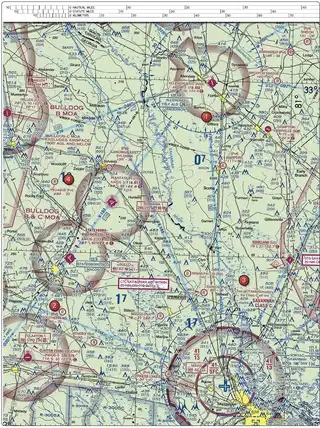
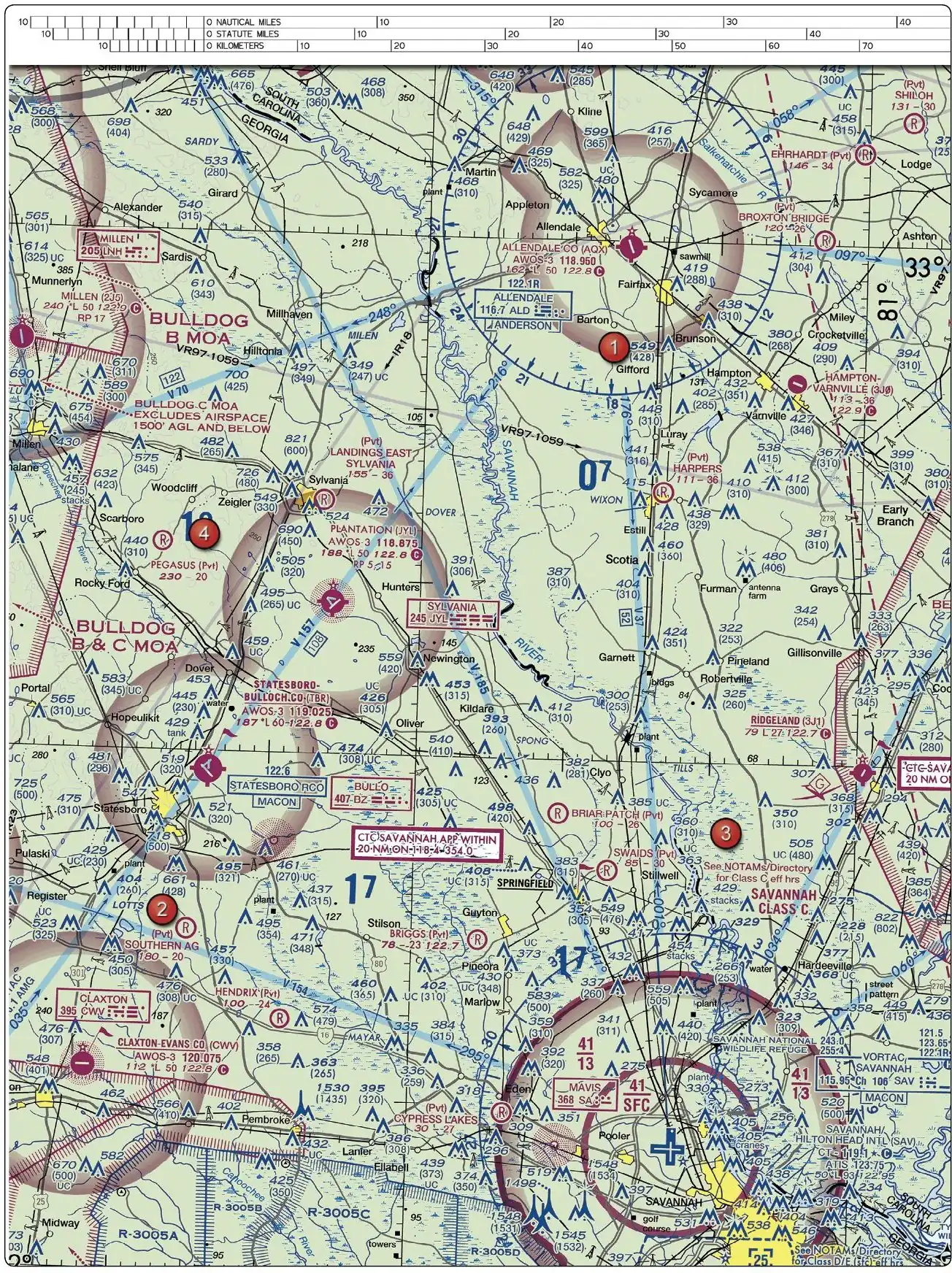
8. (Refer to Figure 23, area 3.) What is the floor of the Savannah Class C airspace at the shelf area (outer circle)?
- A. 1,700 feet MSL.
- B. 1,300 feet AGL.
- C. 1,300 feet MSL.
Show answer
Correct answer: C. 1,300 feet MSL.
Class C shelves are labeled like a fraction: 41/13 means ceiling 4,100 ft MSL over a floor of 1,300 ft MSL. Sectional chart altitudes are MSL unless explicitly marked AGL: that single letter is what this question is really testing. Under the shelf you are still inside the lateral boundary but below the floor, so that airspace is not Class C, and LAANC grids may still apply nearby.
ACS code: UA.II.A.K1b
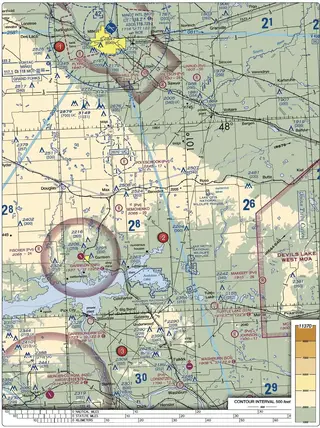
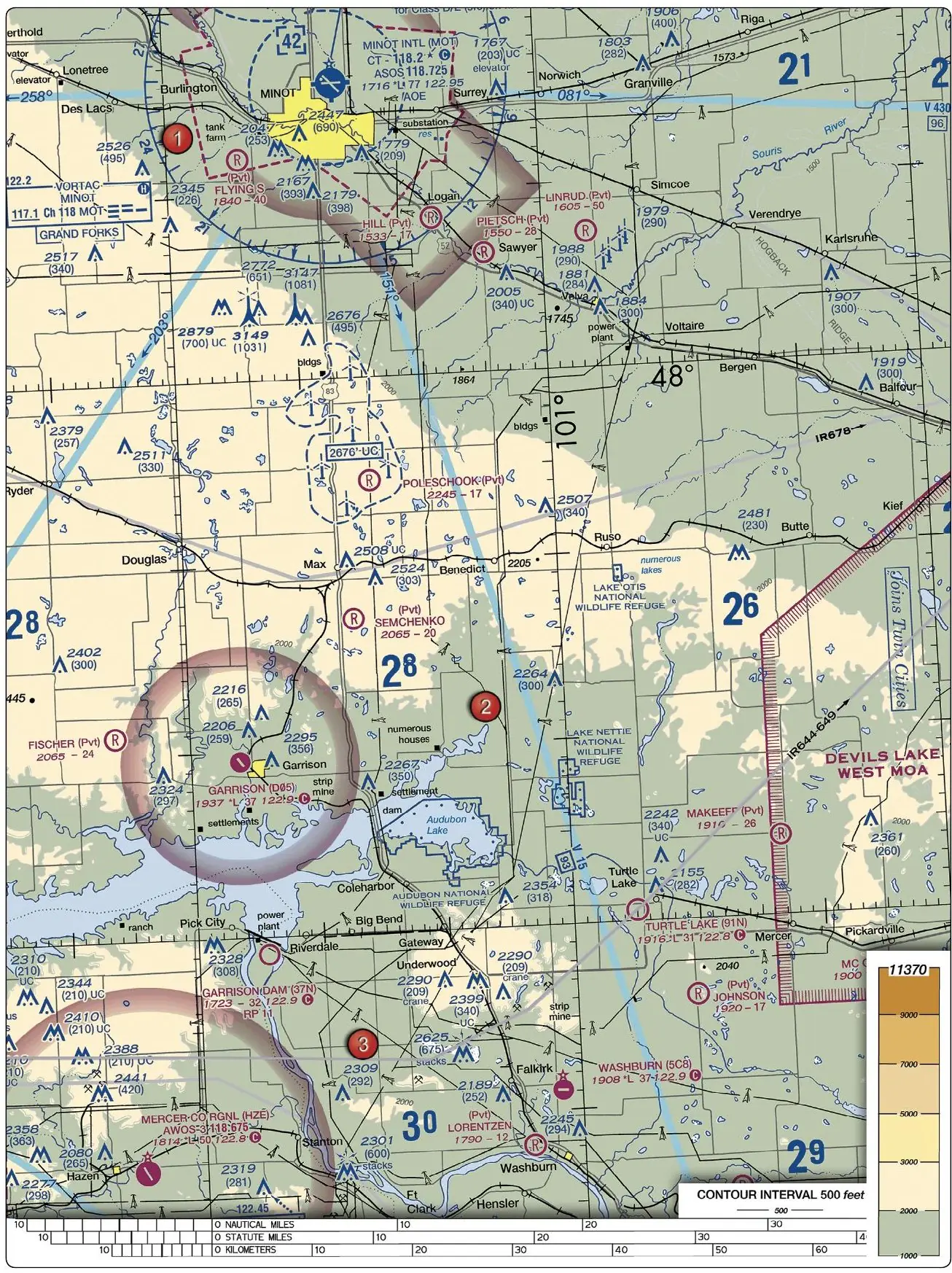
10. (Refer to Figure 21.) You have been hired by a farmer to use your small UA to inspect his crops. The area that you are to survey is in the Devil's Lake West MOA, east of area 2. How would you find out if the MOA is active?
- A. This information is available in the Small UAS database.
- B. Refer to the Military Operations Directory.
- C. Refer to the chart legend.
Show answer
Correct answer: C. Refer to the chart legend.
Every sectional chart carries a tabulation of its special use airspace: name, altitudes, times of use and controlling agency. That panel is part of the chart legend, which is why the legend is the correct place to start. A 'Small UAS database' and a 'Military Operations Directory' do not exist; for real-time status you would additionally check NOTAMs or contact the controlling agency.
ACS code: UA.II.A.K2
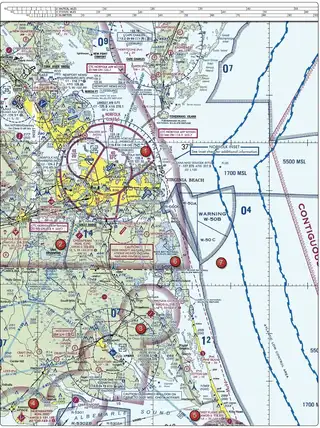
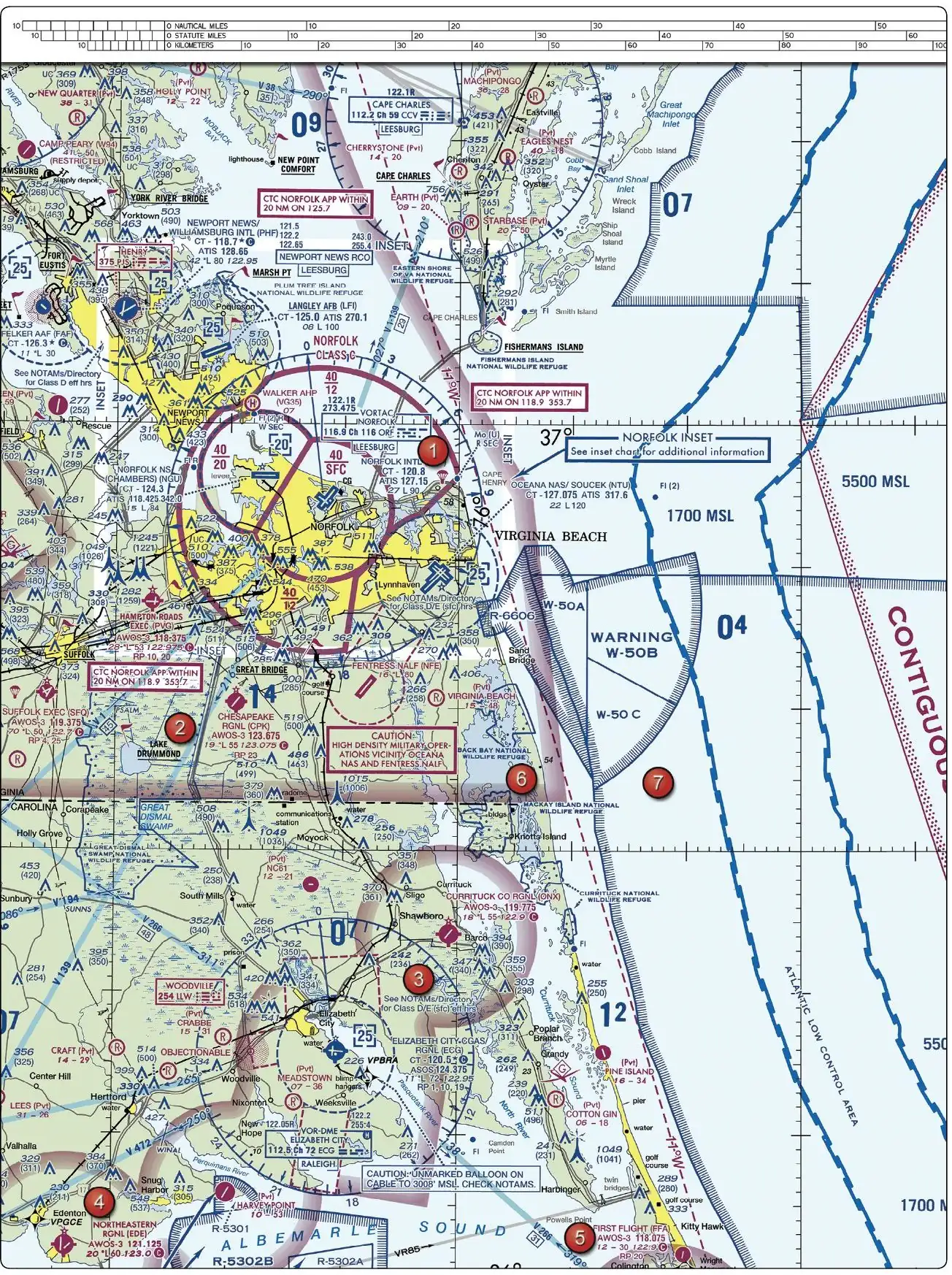
14. (Refer to Figure 20, area 5.) How would a remote PIC "CHECK NOTAMS" as noted in the CAUTION box regarding the unmarked balloon?
- A. By utilizing the B4UFLY mobile application.
- B. By obtaining a briefing via an online source such as: 1800WXBrief.com.
- C. By contacting the FAA district office.
Show answer
Correct answer: B. By obtaining a briefing via an online source such as: 1800WXBrief.com.
NOTAMs are distributed through the Flight Service briefing system: online at 1800WXBrief.com (or by phone at 1-800-WX-BRIEF). B4UFLY shows airspace, not the full NOTAM picture, and the local FSDO is not a briefing facility. When a chart tells you to 'check NOTAMs', it means: get a briefing before you fly.
ACS code: UA.II.B.K5
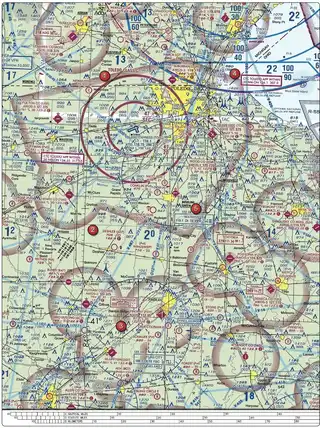
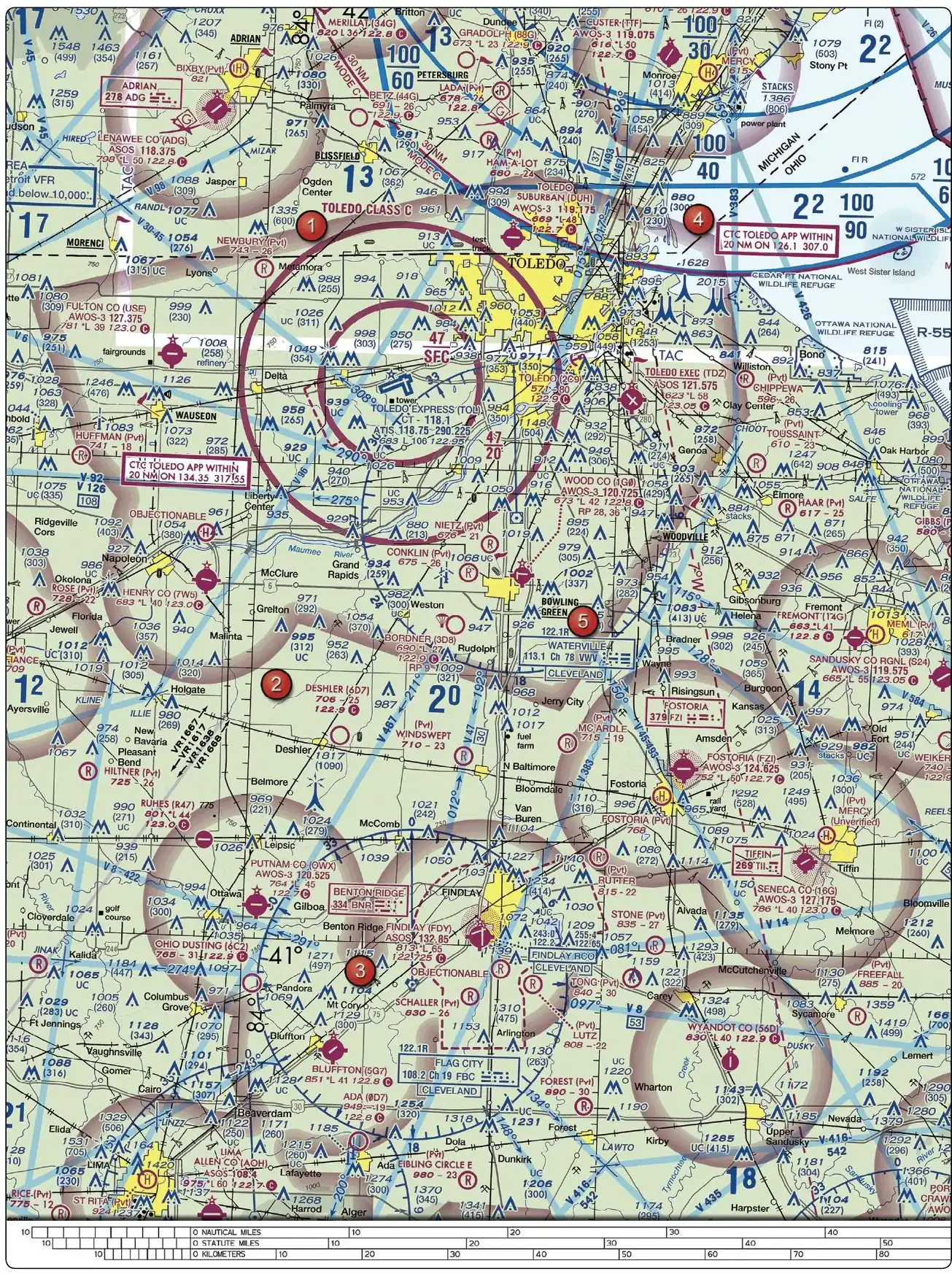
30. (Refer to Figure 59, area 2.) The chart shows a gray line with "VR1667, VR1617, VR1638, and VR1668." Could this area present a hazard to the operations of a small UA?
- A. Yes, the defined route provides traffic separation to manned aircraft.
- B. Yes, this is a Military Training Route from the surface to 1,500 feet AGL.
- C. No, all operations will be above 400 feet.
Show answer
Correct answer: B. Yes, this is a Military Training Route from the surface to 1,500 feet AGL.
Military Training Route numbering encodes altitude: four digits (VR1667) mean the route has no segment above 1,500 ft AGL, exactly where your drone flies; three digits would mean segments above 1,500 ft. VR routes are flown fast (over 250 knots) and low, so they absolutely matter to sUAS. MTRs provide no separation service.
ACS code: UA.II.A.K2
46. Your surveying company is a title sponsor for a race team at the Indianapolis 500. To promote your new aerial surveying department, you decide to video part of the race using a small UA. The FAA has issued a Temporary Flight Restriction (TFR) for the race in the area you plan to fly. In this situation
- A. flying your drone is allowed if you notify all non-participating people of the closed course UA operation.
- B. you may fly your drone in the TFR since your company is sponsoring a team at the race.
- C. the TFR applies to all aircraft; you may not fly in the area without a Certificate of Waiver or Authorization.
Show answer
Correct answer: C. the TFR applies to all aircraft; you may not fly in the area without a Certificate of Waiver or Authorization.
A TFR closes the airspace to everyone who is not specifically authorized: sponsorship, media credentials or notifying bystanders change nothing. Stadium/racing TFRs are standing restrictions over major sporting events. The only way in is a specific FAA authorization or waiver naming your operation. Always check TFRs in your preflight briefing; violating one is one of the fastest ways to lose your certificate.
ACS code: UA.II.A.K3
Weather
1. What are characteristics of a moist, unstable air mass?
- A. Haze and smoke.
- B. Turbulence and showery precipitation.
- C. Poor visibility and smooth air.
Show answer
Correct answer: B. Turbulence and showery precipitation.
Unstable air rises and keeps rising: that vertical motion builds cumulus clouds, showers and turbulence, while constantly stirring the air clean (good visibility). Stable air is the opposite: smooth, hazy, poor visibility, steady precipitation. Memory hook: UNstable = UNcomfortable but clear; stable = smooth but murky.
ACS code: UA.III.B.K1d
4. What effect does high density altitude have on the efficiency of a UA propeller?
- A. Propeller efficiency is decreased.
- B. Density altitude does not affect propeller efficiency.
- C. Propeller efficiency is increased.
Show answer
Correct answer: A. Propeller efficiency is decreased.
High density altitude means thin air: hot days, high elevations, high humidity. A propeller is a rotating wing: with fewer air molecules to grip, it produces less thrust at the same RPM. Expect longer spin-up, weaker climb and shorter battery life on hot summer days. 'High and hot' always costs performance.
ACS code: UA.III.B.K1a
25. (Refer to Figure 12.) What are the current conditions for Chicago Midway Airport (KMDW)?
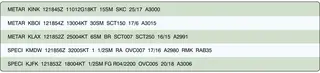
- A. Sky 7,000 feet overcast, visibility 1-1/2SM, heavy rain.
- B. Sky 700 feet overcast, visibility 11, occasionally 2SM, with rain.
- C. Sky 700 feet overcast, visibility 1-1/2SM, rain.
Show answer
Correct answer: C. Sky 700 feet overcast, visibility 1-1/2SM, rain.
Decode the METAR piece by piece: OVC007 = overcast at 700 ft (cloud heights are in hundreds of feet), 1 1/2SM = visibility one and a half statute miles, -RA = light rain (the minus sign means light, a plus would mean heavy). The classic traps are misreading 007 as 7,000 ft and ignoring the intensity prefix.
ACS code: UA.III.A.K2
26. (Refer to Figure 12.) The wind direction and velocity at KJFK is from
- A. 180° true at 4 knots.
- B. 180° magnetic at 4 knots.
- C. 040° true at 18 knots.
Show answer
Correct answer: A. 180° true at 4 knots.
18004KT reads as: wind FROM 180° at 4 knots. Written METAR winds are always TRUE north references: only winds spoken over the radio (ATIS, tower) are magnetic. Remember: 'if you read it, it's true; if you hear it, it's magnetic.'
ACS code: UA.III.A.K2
38. What are the characteristics of stable air?
- A. Good visibility and steady precipitation.
- B. Poor visibility and steady precipitation.
- C. Poor visibility and intermittent precipitation.
Show answer
Correct answer: B. Poor visibility and steady precipitation.
Stable air resists vertical motion: pollutants and haze stay trapped (poor visibility), clouds form in flat stratus layers, and precipitation falls steadily rather than in showers. The complete stable-air package: smooth air, poor visibility, stratus clouds, steady precipitation, the exact mirror image of unstable air.
ACS code: UA.III.B.K1c
39. You have received an outlook briefing from flight service through 1800wxbrief.com. The briefing indicates you can expect a low-level temperature inversion with high relative humidity. What weather conditions would you expect?
- A. Smooth air, poor visibility, fog, haze, or low clouds.
- B. Turbulent air, poor visibility, fog, low stratus type clouds, and showery precipitation.
- C. Light wind shear, poor visibility, haze, and light rain.
Show answer
Correct answer: A. Smooth air, poor visibility, fog, haze, or low clouds.
A temperature inversion is a lid of warm air over cooler surface air: the definition of stability. Add high humidity and the trapped moisture condenses into fog, haze and low clouds. Because the inversion suppresses vertical motion, the air is smooth; anything 'showery' or 'turbulent' in an answer immediately disqualifies it.
ACS code: UA.III.B.K1j
Loading & Performance
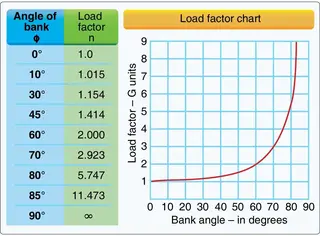
7. (Refer to Figure 2.) If an unmanned airplane weighs 33 pounds, what approximate weight would the airplane structure be required to support during a 30° banked turn while maintaining altitude?
- A. 47 pounds.
- B. 38 pounds.
- C. 34 pounds.
Show answer
Correct answer: B. 38 pounds.
The load factor chart shows about 1.154 G for a level 30° bank. 33 lb × 1.154 ≈ 38 lb. The physics: in a bank, lift must both hold the aircraft up and pull it around the turn, so the structure carries more than the aircraft's weight. At 60° bank the factor reaches 2 G: double the weight, and a favorite exam variation.
ACS code: UA.IV.A.K1a
20. When operating an unmanned airplane, the remote pilot should consider that the load factor on the wings may be increased any time
- A. the airplane is subjected to maneuvers other than straight-and-level flight.
- B. the CG is shifted rearward to the aft CG limit.
- C. the gross weight is reduced.
Show answer
Correct answer: A. the airplane is subjected to maneuvers other than straight-and-level flight.
Load factor rises whenever lift must exceed weight: in turns, pull-ups, gusts: any maneuver beyond straight-and-level flight. CG position affects stability and control, not load factor, and reducing gross weight lowers structural stress rather than raising it. Aggressive maneuvering with a heavy payload is how airframes get overstressed.
ACS code: UA.IV.A.K1a
21. A stall occurs when the smooth airflow over the unmanned airplane's wing is disrupted and the lift degenerates rapidly. This is caused when the wing
- A. exceeds maximum allowable operating weight.
- B. exceeds its critical angle of attack.
- C. exceeds the maximum speed.
Show answer
Correct answer: B. exceeds its critical angle of attack.
A stall is purely about angle of attack: exceed the critical angle (typically around 15 to 17°) and the airflow separates from the wing, regardless of airspeed. That is why an aircraft can stall at any speed and in any attitude: for example in a steep, heavily loaded turn. Speed and weight change WHERE the stall happens, never WHY.
ACS code: UA.IV.A.K1b
28. To ensure that the unmanned aircraft center of gravity (CG) limits are not exceeded, follow the aircraft loading instructions specified in the
- A. Aircraft Weight and Balance Handbook.
- B. Aeronautical Information Manual (AIM).
- C. Pilot's Operating Handbook or UAS Flight Manual.
Show answer
Correct answer: C. Pilot's Operating Handbook or UAS Flight Manual.
CG limits are aircraft-specific, so they live in the manufacturer's documentation: the POH or UAS Flight Manual. The AIM explains procedures for the whole national airspace system, and the FAA's Weight and Balance Handbook teaches general theory: neither contains YOUR aircraft's loading limits. Mount a payload outside the manual's limits and stability suffers first.
ACS code: UA.IV.A.K1b
Operations
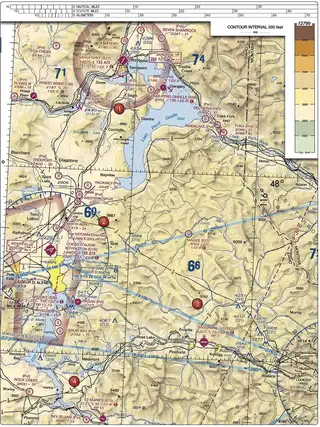
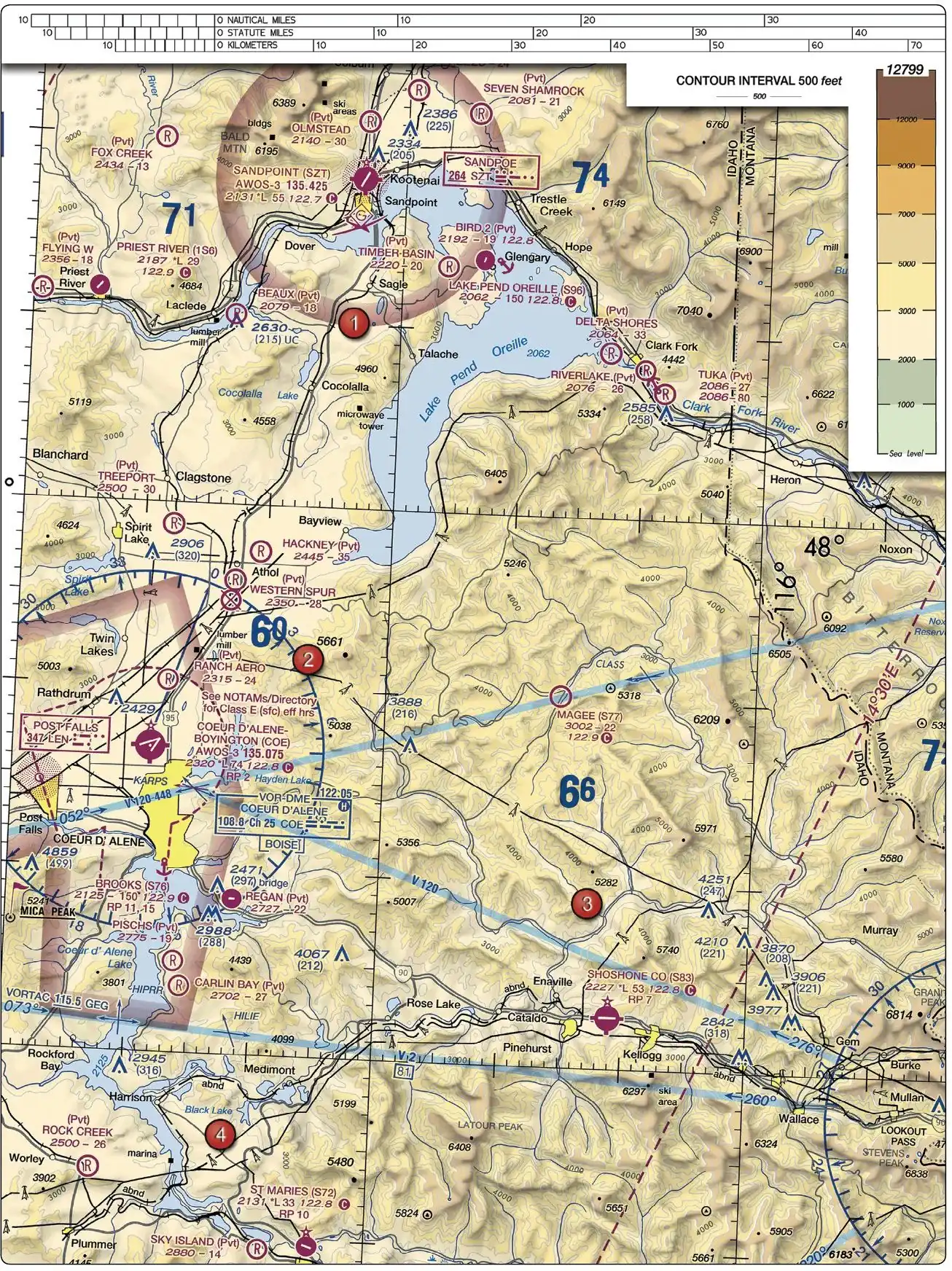
5. (Refer to Figure 22, area 2.) At Coeur D'Alene which frequency should be used as a Common Traffic Advisory Frequency (CTAF) to monitor airport traffic?
- A. 122.05 MHz.
- B. 135.075 MHz.
- C. 122.8 MHz.
Show answer
Correct answer: C. 122.8 MHz.
The CTAF is marked on the chart with a magenta letter C right after the frequency: at Coeur d'Alene that is 122.8. The other numbers in the airport data block are traps: 135.075 is the AWOS weather broadcast, 122.05 belongs to Flight Service. Monitoring the CTAF tells you where manned traffic is in the pattern.
ACS code: UA.V.B.K6a
9. (Refer to Figure 20, area 3.) With ATC authorization, you are operating your small unmanned aircraft approximately 4 SM southeast of Elizabeth City Regional Airport (ECG). What hazard is indicated to be in that area?
- A. High density military operations in the vicinity.
- B. Unmarked balloon on a cable up to 3,008 feet MSL.
- C. Unmarked balloon on a cable up to 3,008 feet AGL.
Show answer
Correct answer: B. Unmarked balloon on a cable up to 3,008 feet MSL.
The CAUTION box near Elizabeth City warns of an unmarked balloon on a cable to 3,008 ft, and like all charted altitudes, that number is MSL unless expressly labeled AGL. The MSL/AGL distinction is the whole question; the tethered cable is nearly invisible and would destroy a drone instantly, which is why the chart shouts about it.
ACS code: UA.V.B.K6a
11. The most comprehensive information on a given airport is provided by
- A. the Chart Supplements U.S. (formerly Airport Facility Directory).
- B. Notices to Airmen (NOTAMS).
- C. Terminal Area Chart (TAC).
Show answer
Correct answer: A. the Chart Supplements U.S. (formerly Airport Facility Directory).
The Chart Supplement is the airport encyclopedia: runways, frequencies, fuel, lighting, hours, remarks, everything about one field in one entry. NOTAMs cover only what has temporarily changed, and a TAC is a chart, showing an airport's position rather than its details. 'Most comprehensive' is the key phrase pointing to the Chart Supplement.
ACS code: UA.V.B.K6b
12. Identify the hazardous attitude or characteristic a remote pilot displays while taking risks in order to impress others?
- A. Invulnerability.
- B. Macho.
- C. Impulsivity.
Show answer
Correct answer: B. Macho.
Taking risks to impress others is the textbook definition of Macho ('watch this!'). The antidote thought is: 'Taking chances is foolish.' The five hazardous attitudes, Anti-authority, Impulsivity, Invulnerability, Macho, Resignation, are guaranteed exam material; learn each with its trigger phrase and antidote.
ACS code: UA.V.D.K4
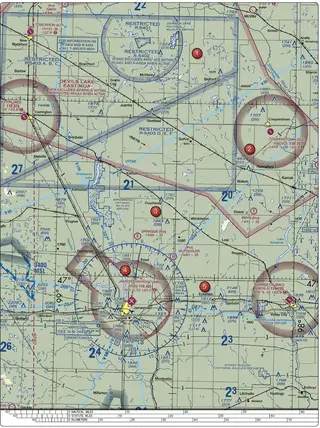
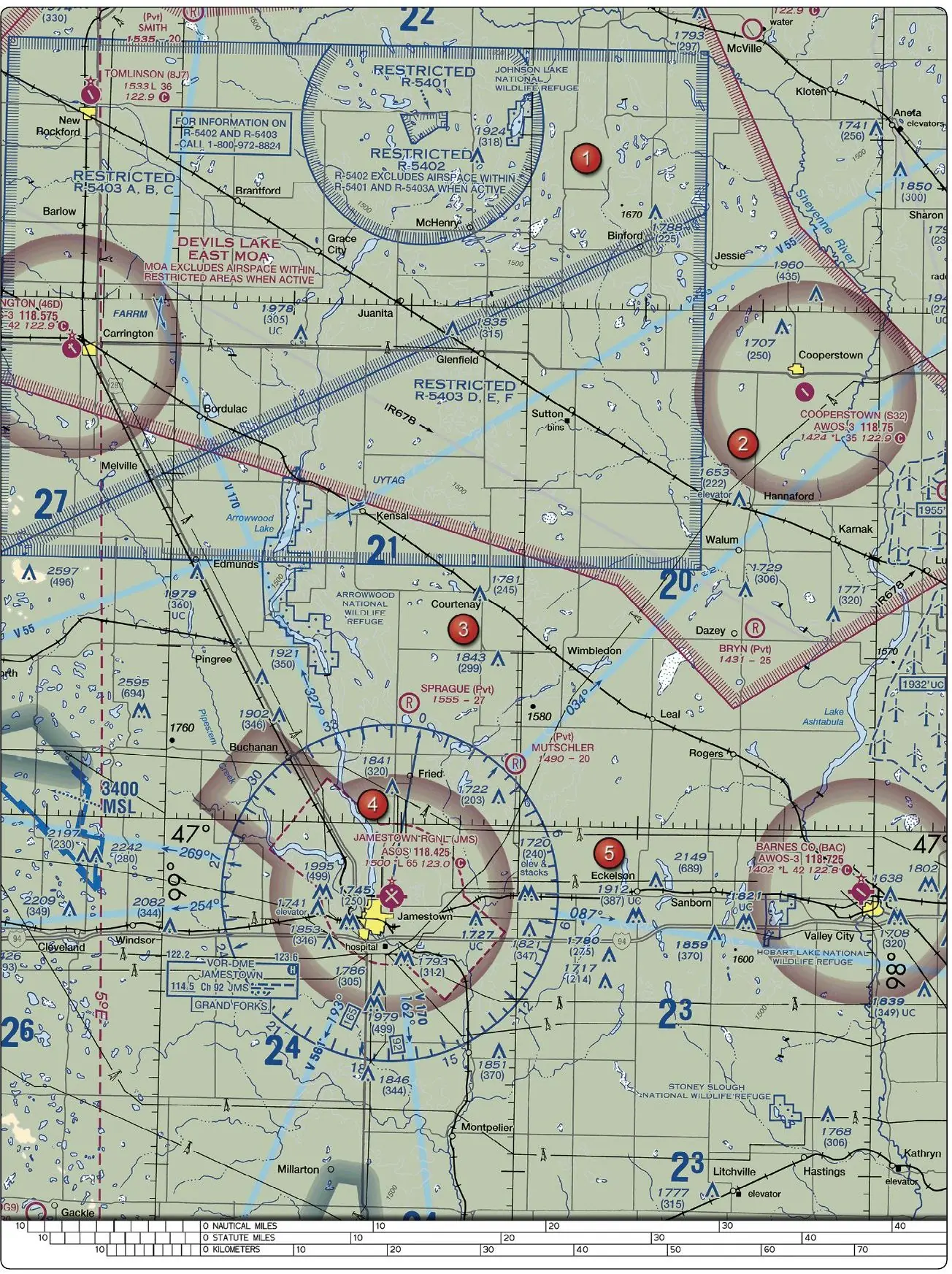
13. (Refer to Figure 26, area 4.) You have been hired to inspect the tower under construction at 46.9N and 98.6W, near Jamestown Regional (JMS). What must you receive prior to flying your unmanned aircraft in this area?
- A. Authorization from the National Park Service.
- B. Authorization from the military.
- C. Authorization from ATC.
Show answer
Correct answer: C. Authorization from ATC.
The dashed magenta line around Jamestown Regional marks Class E surface airspace, controlled airspace beginning at the ground. Under § 107.41 that requires prior ATC authorization just like Class D. The tower's location inside that boundary is what the coordinates lead you to discover; neither the military nor the Park Service controls this airspace.
ACS code: UA.V.B.K6a
15. When adapting crew resource management (CRM) concepts to the operation of a small UA, CRM must be integrated into
- A. all phases of the operation.
- B. the communications only.
- C. the flight portion only.
Show answer
Correct answer: A. all phases of the operation.
CRM means using every available resource: people, equipment, information, and it starts with mission planning, runs through preflight and flight, and ends with the debrief. Limiting it to the flight or to communications misses the point: most accidents trace back to decisions made before takeoff. 'All phases' is the answer whenever CRM scope is asked.
ACS code: UA.V.D.K2
16. You have been hired as a remote pilot by a local TV news station to film breaking news with a small UA. You expressed a safety concern and the station manager has instructed you to 'fly first, ask questions later.' What type of hazardous attitude does this attitude represent?
- A. Machismo.
- B. Invulnerability.
- C. Impulsivity.
Show answer
Correct answer: C. Impulsivity.
'Fly first, ask questions later' is 'do it quickly' in disguise: the Impulsivity attitude: acting without thinking things through. The antidote: 'Not so fast. Think first.' It differs from Macho (showing off) and Invulnerability ('it won't happen to me'). Note that the pressure comes from the manager, but as remote PIC the go/no-go decision is yours.
ACS code: UA.V.D.K4
17. A local TV station has hired a remote pilot to operate their small UA to cover news stories. The remote pilot has had multiple near misses with obstacles on the ground and two small UAS accidents. What would be a solution for the news station to improve their operating safety culture?
- A. The news station should recognize hazardous attitudes and situations and develop standard operating procedures that emphasize safety.
- B. The news station should implement a policy of no more than five crashes/incidents within 6 months.
- C. The news station does not need to make any changes; there are times that an accident is unavoidable.
Show answer
Correct answer: A. The news station should recognize hazardous attitudes and situations and develop standard operating procedures that emphasize safety.
A pattern of near misses signals a systemic problem, and the systemic fix is safety culture: recognize hazardous attitudes and write standard operating procedures that put safety first. A crash quota normalizes accidents, and 'accidents happen' is the Resignation attitude at company scale. On safety-culture questions, the SOP answer wins.
ACS code: UA.V.D.K1
18. (Refer to Figure 26, area 2.) While monitoring the Cooperstown CTAF you hear an aircraft announce that they are midfield left downwind to RWY 13. Where would the aircraft be relative to the runway?
- A. The aircraft is West.
- B. The aircraft is East.
- C. The aircraft is South.
Show answer
Correct answer: B. The aircraft is East.
Work it in three steps: runway 13 points to about 130° (southeast). Downwind is flown opposite, heading about 310°. In a LEFT pattern the runway lies off the pilot's left side, which places the downwind leg northeast of the field: East among the choices. Being able to place pattern traffic from radio calls is exactly the skill this tests.
ACS code: UA.V.A.K3
19. To avoid a possible collision with a manned airplane, you estimate that your small UA climbed to an altitude greater than 600 feet AGL. To whom must you report the deviation?
- A. The National Transportation Safety Board.
- B. Air Traffic Control.
- C. Upon request of the Federal Aviation Administration.
Show answer
Correct answer: C. Upon request of the Federal Aviation Administration.
§ 107.21 lets the remote PIC deviate from any rule of this part as far as needed to meet an in-flight emergency, and it asks for a written report only upon request of the FAA, never automatically and never to ATC. Keep that apart from § 107.9, the accident rule: that report also goes to the FAA, within 10 calendar days, and only for a serious injury, any loss of consciousness, or damage to other property whose repair cost or fair market value exceeds $500. The NTSB is not part of the part 107 reporting chain at all. A climb to avoid a collision crosses none of those thresholds, so nothing is filed unless the FAA asks.
ACS code: UA.V.C.K1
22. Safety is an important element for a remote pilot to consider prior to operating an unmanned aircraft system. To prevent the final "link" in the accident chain, a remote pilot must consider which methodology?
- A. Safety Management System.
- B. Crew Resource Management.
- C. Risk Management.
Show answer
Correct answer: C. Risk Management.
Accidents build as a chain of small events; breaking any link prevents the crash, and the tool for finding and breaking links is Risk Management, identify hazards, assess risk, mitigate. CRM is about using your resources and SMS is an organizational framework; the 'accident chain' phrasing points specifically to risk management.
ACS code: UA.V.D.K1
23. You are a remote pilot for a co-op energy service provider. You are to use your UA to inspect power lines in a remote area 15 hours away from your home office. After the drive, fatigue impacts your abilities to complete your assignment on time. Fatigue can be recognized
- A. easily by an experienced pilot.
- B. as being in an impaired state.
- C. by an ability to overcome sleep deprivation.
Show answer
Correct answer: B. as being in an impaired state.
Fatigue is an impaired state comparable to alcohol intoxication, degraded judgment, attention and reaction time. Its danger is that it is NOT easily self-recognized: the tired brain rates itself as fine. Experience does not immunize you, and 'pushing through' sleep deprivation is a myth. After a 15-hour drive, the professional call is to delay the flight.
ACS code: UA.V.E.K5
24. (Refer to Figure 21.) What airport is located approximately 47 (degrees) 40 (minutes) N latitude and 101 (degrees) 26 (minutes) W longitude?
- A. Garrison Airport.
- B. Semshenko Airport.
- C. Mercer County Regional Airport.
Show answer
Correct answer: A. Garrison Airport.
Latitude lines run horizontally (47°40'N sits two-thirds of the way from 47° toward 48°), longitude lines vertically (101°26'W is about halfway between 101° and 102°, remembering longitude increases westward). The intersection lands on Garrison. Each printed tick is one minute; count carefully, Mercer County sits noticeably south.
ACS code: UA.V.B.K6a
31. (Refer to Figure 26.) What does the line of latitude at area 4 measure?
- A. The degrees of latitude east and west of the line that passes through Greenwich, England.
- B. The degrees of latitude east and west of the Prime Meridian.
- C. The degrees of latitude north and south of the equator.
Show answer
Correct answer: C. The degrees of latitude north and south of the equator.
Latitude measures north-south from the equator (0°) to the poles (90°); longitude measures east-west from the Prime Meridian through Greenwich. Both wrong answers describe longitude. Memory hook: latitude lines look like the rungs of a LADDER lying flat, 'ladder-tude'.
ACS code: UA.V.B.K6a
32. Under what condition should the operator of a small UA establish scheduled maintenance protocol?
- A. UAS does not need a required maintenance schedule.
- B. When the manufacturer does not provide a maintenance schedule.
- C. When the FAA requires you to, following an accident.
Show answer
Correct answer: B. When the manufacturer does not provide a maintenance schedule.
Best practice per the FAA: follow the manufacturer's maintenance schedule, and if the manufacturer does not provide one, create your own based on operating experience (flight hours, battery cycles, wear items). Waiting for an accident or skipping maintenance entirely contradicts the preventive purpose of § 107.15, which requires the aircraft to be in a condition for safe operation.
ACS code: UA.V.F.K1
33. According to 14 CFR part 107, the responsibility to inspect the small UAS to ensure it is in a safe operating condition rests with the
- A. remote pilot-in-command.
- B. owner of the small UAS.
- C. visual observer.
Show answer
Correct answer: A. remote pilot-in-command.
§ 107.49 makes the preflight inspection the remote PIC's duty, before EACH flight, check the aircraft, control links, batteries and payload security. Ownership is irrelevant: if you fly a company or rented drone, you inspect it. The visual observer helps see and avoid, but carries no inspection responsibility. When Part 107 asks 'who is responsible', the answer is almost always the remote PIC.
ACS code: UA.V.F.K2
36. Which is true regarding the presence of alcohol within the human body?
- A. Consuming an equal amount of water will increase the destruction of alcohol and alleviate a hangover.
- B. Judgment and decision-making abilities can be adversely affected by even small amounts of alcohol.
- C. A small amount of alcohol increases vision acuity.
Show answer
Correct answer: B. Judgment and decision-making abilities can be adversely affected by even small amounts of alcohol.
Judgment is the first thing alcohol degrades: at levels far below legal driving limits. Only time metabolizes alcohol; water, coffee and food do not speed it up. The Part 107 numbers to memorize: no flying within 8 hours of consuming alcohol, with a BAC of 0.04 or more, or while under the influence.
ACS code: UA.V.E.K2
37. When using a small UA in a commercial operation, who is responsible for briefing the participants about emergency procedures?
- A. The lead visual observer.
- B. The FAA inspector-in-charge.
- C. The remote PIC.
Show answer
Correct answer: C. The remote PIC.
Another 'who is responsible' question, same answer: the remote PIC. § 107.49 requires the remote PIC to ensure all persons involved in the operation are briefed on operating conditions, emergency procedures, contingency plans, roles and potential hazards before flight. Observers participate in the briefing; they do not conduct it.
ACS code: UA.V.C.K1
43. When preparing for a night flight, what should an sUAS pilot be aware of after assembling and conducting a preflight of an aircraft while using a bright flashlight or work light?
- A. Once adapted to darkness, a persons eyes are relatively immune to bright lights.
- B. The person should use a flash light equipped with LED lights to facilitate their night vision.
- C. It takes approximately 30 minutes for a persons eyes to fully adapt to darkness.
Show answer
Correct answer: C. It takes approximately 30 minutes for a persons eyes to fully adapt to darkness.
Full dark adaptation of the rods takes about 30 minutes, and one glance into a bright white light resets the clock. Plan your night operation so bright preflight lighting ends well before launch, then protect adaptation with dim red or low-intensity lighting. Bright white LEDs are the worst choice for preserving night vision, not a help.
ACS code: UA.V.E.K8
Common questions
Is this Part 107 practice test free?
Yes. All 46 questions, the explanations and the charts on this page are free to use, with no sign-up and no account. Your answers stay in your browser and are not stored.
Are these real FAA questions?
Yes. The questions and figures come from the FAA's official Remote Pilot (UAG) sample questions, a public domain work of the U.S. Government. The FAA does not publish an answer key, so the answers and explanations are provided by Part 107 Prep and are not official.
How many questions are on the real test?
The Unmanned Aircraft General, Small (UAG) test has 60 multiple-choice questions, each with three answer options. You have 2 hours to complete it.
What score do I need to pass?
The passing score is 70%, which means at least 42 correct answers out of 60. A practice score on this page does not predict your real test result.
Where can I practice more?
The FAA provides free official study material. Part 107 Prep offers free daily practice in the app, and Premium adds 300+ exam-style questions, real FAA charts with pinch-to-zoom and a full exam simulation.